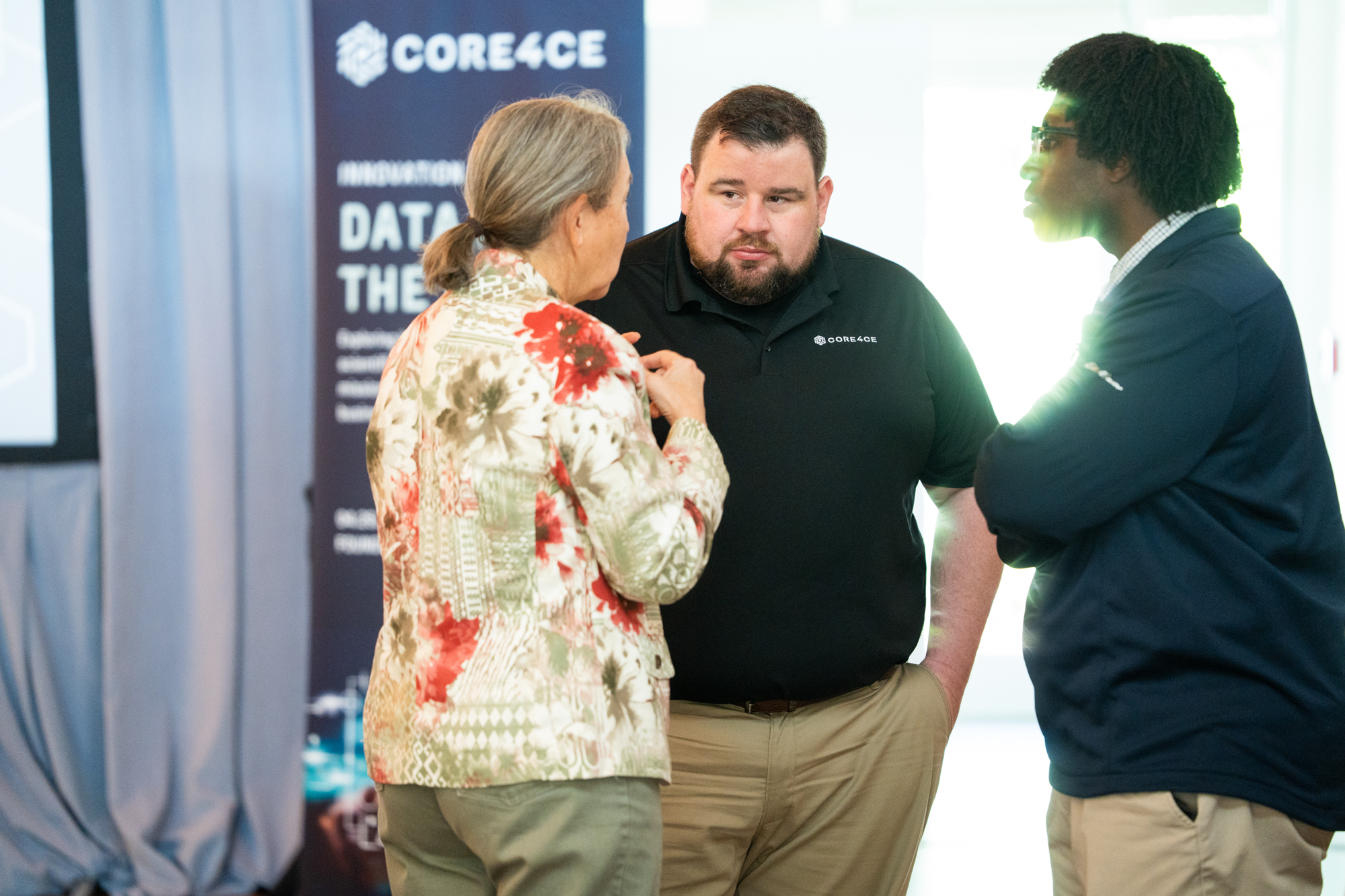
Chief Scientists are Core4ce’s highest-ranking technical leaders—entrusted with shaping our innovation strategy, guiding enterprise-level technical direction, and advancing the communities of practice that drive our long-term mission success. This is the final in a series of four spotlights on our current chief scientists.
Rick Hubbard was appointed Chief Scientist in May 2025 and leads the Autonomy, Artificial Intelligence, and Machine Learning (AAIM) Lab at Core4ce. He is known for building a cross-disciplinary team of researchers and scientists to tackle some of the most difficult AI challenges facing the Department of War and the Intelligence Community. Under his leadership, the AAIM Lab developed an AI-enabled acquisition and contracting platform for the U.S. Air Force, designed to help the service acquire high-technology products at the speed of relevance and reduce acquisition timelines by years.
Before joining Azimuth (acquired by Core4ce), Hubbard began his career as a computer and research engineer at Belcan and later Etegent Technologies – where he worked closely with the Department of War on one of the first government projects that integrated AI into military capabilities.

From AI as a Tool to AI as a Teammate: A Conversation with Chief Scientist Rick Hubbard
We recently had the opportunity to sit down with Chief Scientist Rick Hubbard for a Q&A where he gave a candid look at what it takes to turn cutting-edge science into real-world defense capability. From the urgency of fielding AI at the “speed of relevance,” to Core4ce’s rare ability to span fundamental research through deployed systems, he shares where innovation is headed, why communication matters as much as technical skill, and the personal experiences and influences that keep the mission grounded and meaningful.
Q: What’s one challenge that keeps you up at night (in a good way)?
A: Deploying AI capabilities at the speed of relevance. We don’t enjoy the same technology gap we’ve had in the past — our adversaries are moving fast, and the margin isn’t just about creating impactful technologies anymore. It’s about getting them fielded where they’ll have real impact in keeping our country and our warfighters safe. That tension between building it right and getting it out the door fast enough to matter is what drives me every day.
Q: What excites you most about the work Core4ce is doing as a company right now?
A: What makes Core4ce unique is that we operate across the full R&D spectrum. We’re doing low-level fundamental research — things like advanced materials science — while simultaneously building applied systems that go directly into the hands of warfighters. A lot of companies do one or the other. We do both, and that means we can take an idea from early-stage science all the way to a fielded capability. That’s rare, and it’s what makes this place exciting to be a part of.
Q: Where do you see the biggest opportunity for innovation in defense R&D?
A: Applying AI as a tool, not the solution. There’s a tendency right now to treat AI as the answer to everything, but the real opportunity is in using it to augment the people and processes that already exist. The DoW has massive volumes of data and incredibly capable people — the gap is in connecting the two. AI’s greatest impact in defense will be as a force multiplier that helps warfighters and analysts make better decisions faster, not as a replacement for human judgment.
Q: What emerging technology or trend are you watching closely?
A: Agentic AI — systems that don’t just answer questions but can plan, use tools, and execute multi-step tasks autonomously. We’re past the era of chatbots. The next wave is AI that can actually do work: run analyses, coordinate across data sources, and take action with appropriate human oversight. That shift from “AI as advisor” to “AI as teammate” is going to fundamentally change how we approach defense operations and R&D.
Q: What keeps you motivated?
A: For me, the purpose behind the work is making sure the men and women who put themselves in harm’s way to protect our freedoms can make it back home to enjoy those freedoms themselves. That’s what keeps the work meaningful.
Q: What advice would you give to students who are preparing to enter the workforce?
A: Be a problem solver. The specific tools and frameworks you’re learning in school will be outdated by the time you graduate — which is exactly why the tools aren’t the point. What matters is seeing a vision and executing on it. The people who succeed are the ones who leverage every tool and opportunity available to make themselves better, and who look at every problem and see an opportunity. That mindset will take you further than any technical skill on a resume.
Q: What’s the most unique work experience that you’ve had? (Any odd jobs?)
A: Before the defense world, I bartended and waited tables for a few years, and then worked as an HVAC service technician while finishing my degree. Neither of those sounds like a path to chief scientist, but they taught me something I use every single day: the ability to communicate is invaluable. Whether you’re explaining a repair to a homeowner or briefing a general, being able to connect with a person on a level they understand will carry you very far in this world.
Q: Favorite podcast, book, or show right now?
A: The last book I read was The Last of the Tin Can Soldiers — it’s an incredible account of what ordinary sailors accomplished under extraordinary circumstances. And I’ll admit to an embarrassing love for NCIS. Sometimes you just need a reliable show that doesn’t require a PhD to follow after a long day.
Q: If you weren’t a chief scientist, what job would you think would be fun to try?
A: Bladesmithing. There’s something deeply satisfying about taking raw steel and shaping it into something functional and beautiful through heat, hammer, and patience. It’s the same problem-solving instinct as engineering — understanding materials, managing variables, iterating toward something better — but you end up with a knife instead of a codebase.
Q: Movie you’ve watched the greatest number of times?
A: I’m the guy who can’t change the channel if certain movies are on. Independence Day, Armageddon, and anything with Chris Farley — if one of those pops up, whatever I was doing can wait. There’s something about big, fun, unapologetic movies that never gets old.
What His Colleagues Are Saying
“Rick plays a central role in shaping how Core4ce approaches complex scientific and technical challenges across the organization. His ability to break down emerging requirements into clear direction helps teams stay aligned and confident as we move into new problem spaces. Rick’s perspective consistently broadens the way we think, whether it’s identifying patterns others haven’t noticed yet or connecting insights to the practical realities of our work. His influence helps steer not just what we’re working on, but how we envision the possibilities ahead.“
– Andrew Speir, Core4ce Senior Vice President of Commercial Services
“Rick brings a rare mix of empathy and rigor to his work, and he bridges mission needs and engineering exceptionally well. He’s genuinely committed to understanding what customers need, why they need it, and the stakes behind it. Rick asks the right questions, listens closely, and pushes for solutions that are credible, testable, and built for real-world use. That clarity and follow-through are what make his leadership and guidance so impactful in an ever-evolving world.”
– Tiffany Behr, Software Engineer