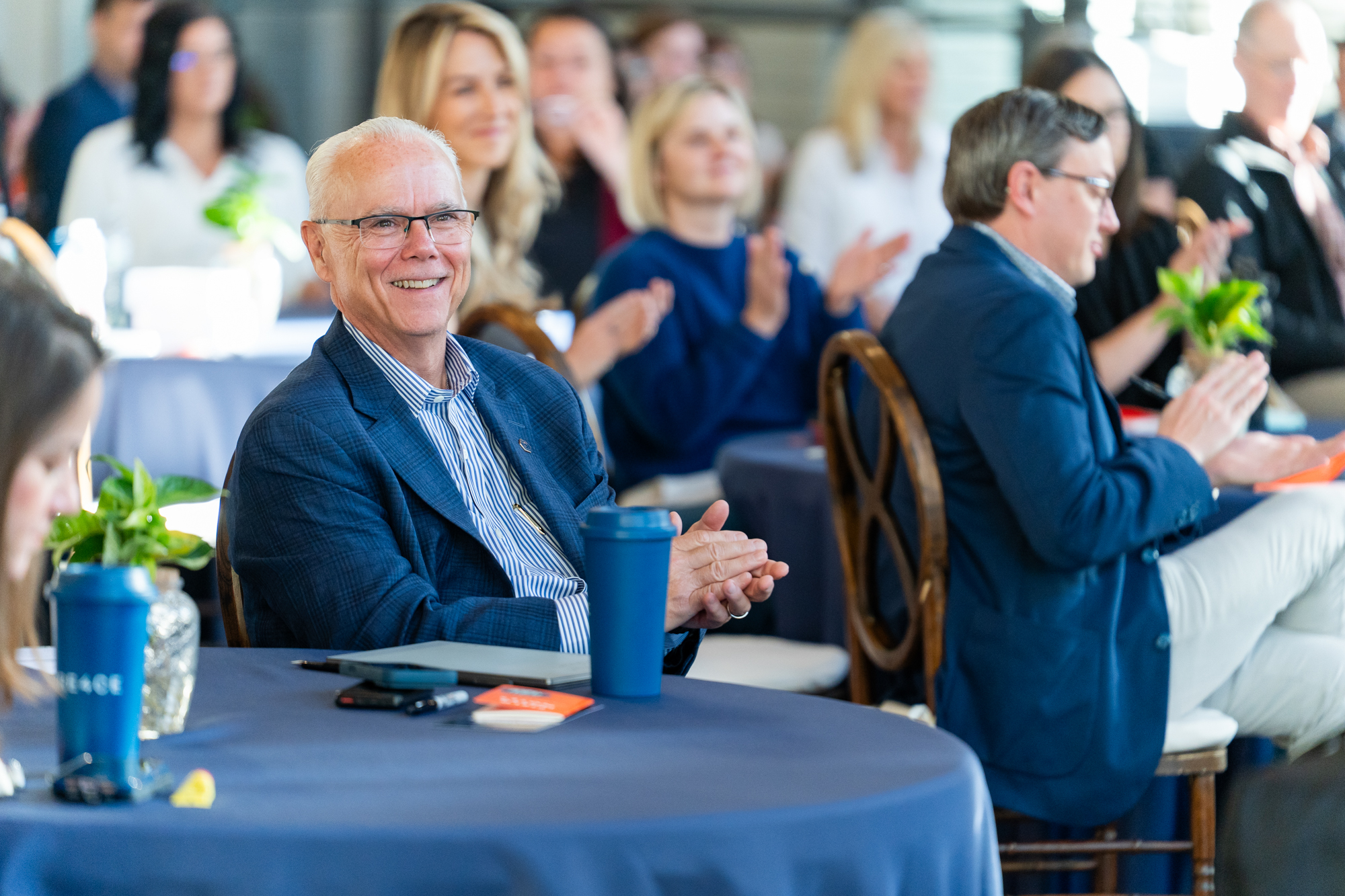
At The Steam Plant, Core4ce scientists and engineers showed how AI, automation, and advanced materials are shortening the path from discovery to fielded capability.
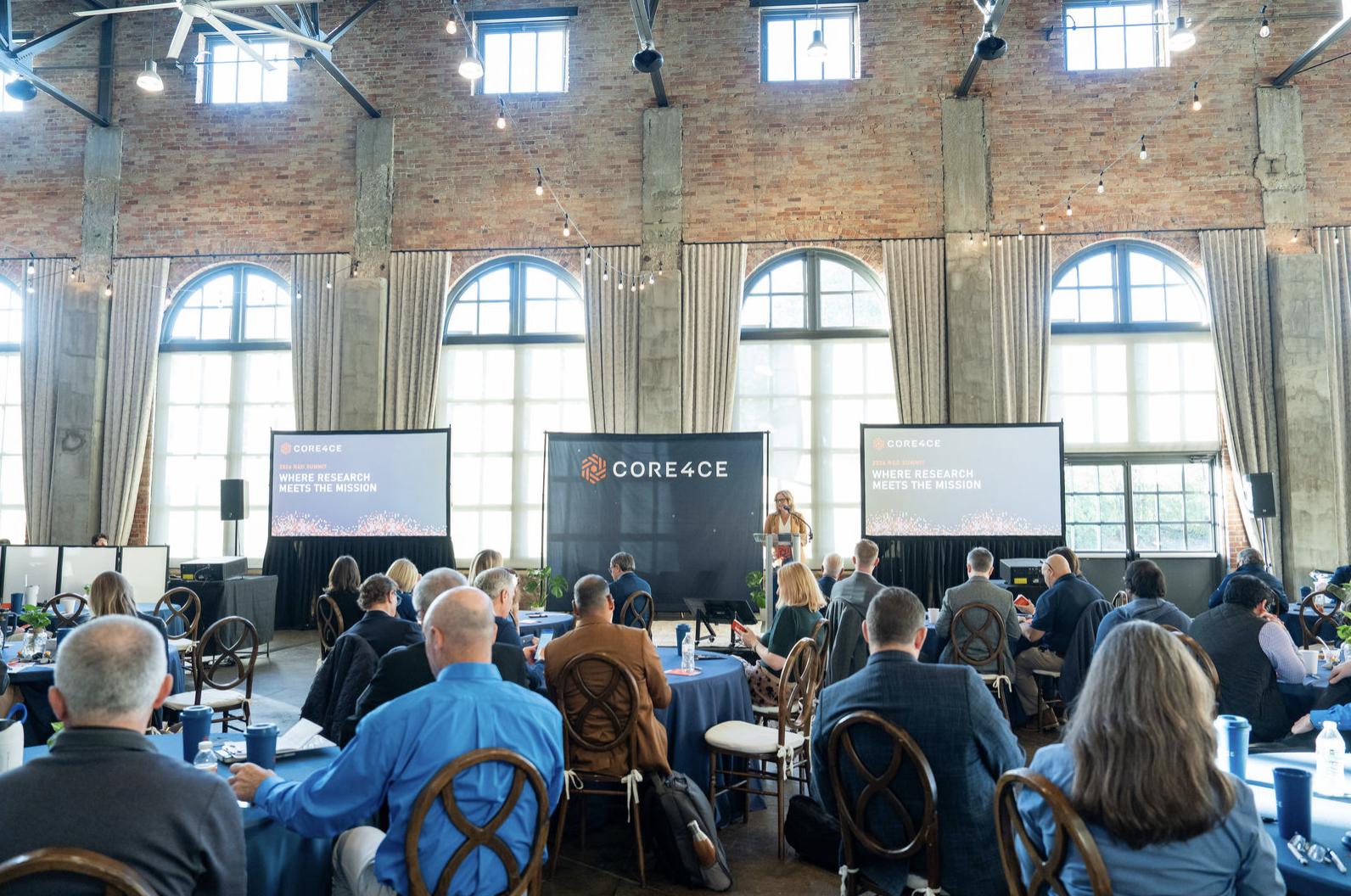
Core4ce’s 2026 Research and Development Summit at The Steam Plant in Dayton, Ohio
On October 20, Core4ce brought together scientists, engineers, and team members from across the company at The Steam Plant in Dayton, Ohio, for its 2026 Research and Development Summit. The theme, “Where Research Meets the Mission,” set the tone for a full day of presentations and panel discussions on the R&D work driving the company forward.
The summit also marked a milestone. It took place two years after Core4ce acquired Azimuth Corporation, a move that expanded the company’s presence into the Dayton market, deepened its scientific bench, and made the Air Force Research Laboratory (AFRL) one of its core customers.
Across the day, attendees heard six talks and five panels covering artificial intelligence, laboratory automation, next-generation defense electronics, photonics, and materials for hypersonic flight. The day closed with a reception on site.
TWO YEARS IN DAYTON
When Core4ce acquired Azimuth Corporation in 2024, it gained a team with decades of collaboration with AFRL and deep expertise in materials science. It also brought Core4ce into the Dayton research community, proximate to Wright-Patterson Air Force Base. Two years later, that foundation has changed what Core4ce can offer the defense community.
“Our decision to join forces with Azimuth Corporation was rooted in the unique expertise and trusted relationships they’ve built across the defense community,” Core4ce CEO Mike Morehouse said when AFRL expanded its MaRSS II contract last year. “Within Core4ce’s Advanced Mission Solutions unit, we are combining our strengths in data and AI with Azimuth’s materials science capabilities to deliver reliable innovation.”
The results show in the contract portfolio and the science:
- MaRSS II. In September 2025, AFRL awarded a $98.7 million ceiling modification to Core4ce’s Materials Research and Survivability Studies II contract. The award brought its cumulative value to $196 million and extended the work through March 2032. The program develops advanced photonic materials that protect aircrew, sensors, and mission systems.
- TOPS VI. Under this contract with AFRL’s Materials and Manufacturing Directorate, Core4ce turns promising basic research into new materials and manufacturing processes for military needs. The work spans computational materials science, thermal protection, lightweight materials for space access, and ultra-wide bandgap semiconductors.
- AI-driven discovery. The AAIM Lab (Autonomy, AI, and Machine Learning) in Dayton puts PhD scientists and software engineers in the same room. Its MAISY design tool cut metasurface development time by 90 percent.
- Published research. Core4ce’s on-site AFRL research teams contributed to an impressive array of scientific papers in 2025 spanning diverse disciplines, including materials science, nanotechnology, optics, and advanced manufacturing.
In his opening remarks at the summit, Morehouse described the company’s commitment to R&D as the path “from bold ideas to fielded capabilities.” The rest of the day showed what that looks like in practice.
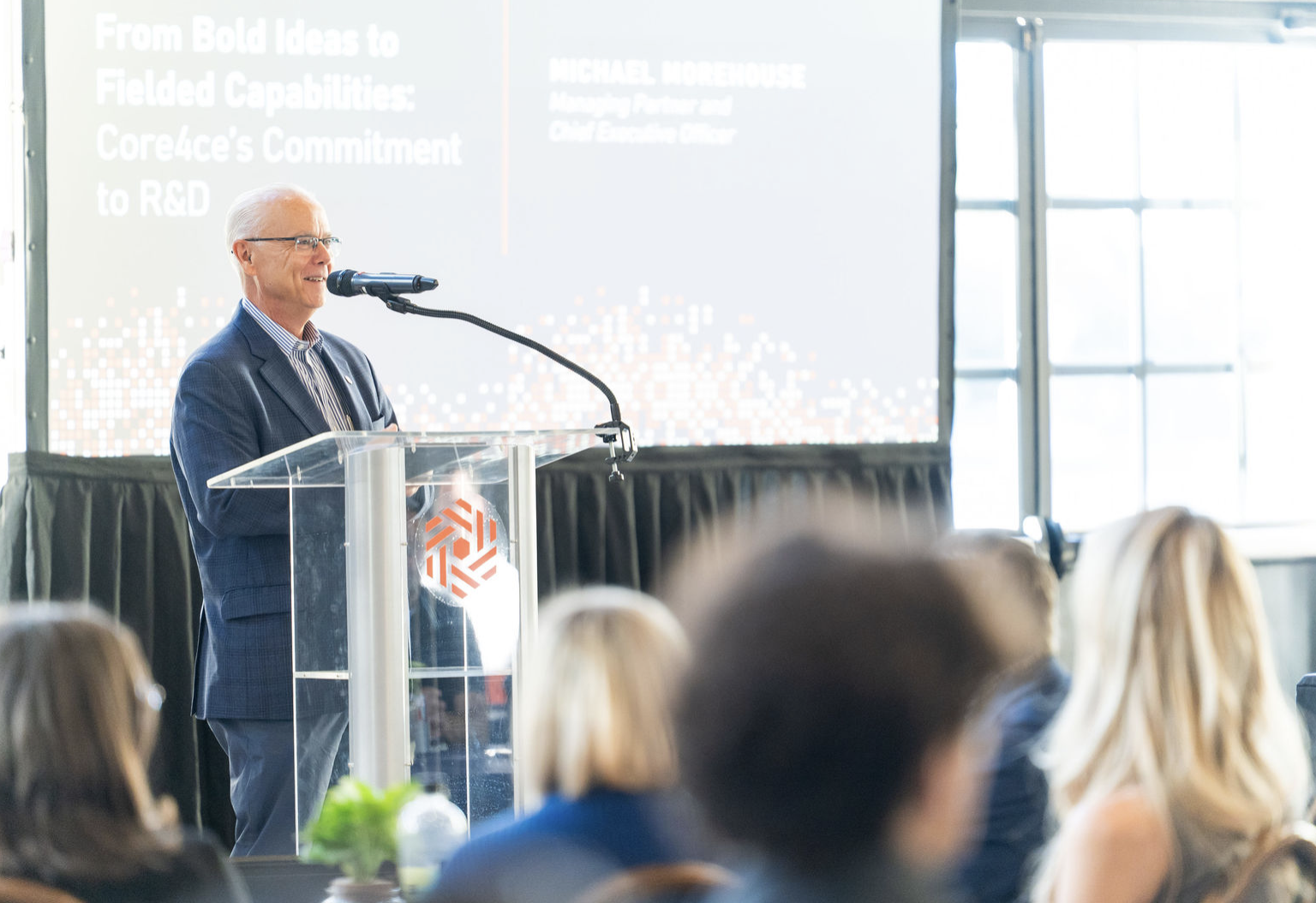
Core4ce Managing Partner and CEO Mike Morehouse
INSIDE THE SUMMIT
AI shortens the path from idea to impact
Chief Scientist Rick Hubbard, who leads the AAIM Lab inside Core4ce’s innovation incubator, The Forge, opened the technical program. His point was simple: research and development are different jobs, but both run the same loop. You ask a question, build something, test it, learn, and go again.
“AI does not replace any step. It shortens each one,” Hubbard said. A simulation stands in for a fabrication run. A working prototype stands in for a requirements document. When trying an idea gets cheap, teams try more of them, and the best ones become products.
Two colleagues then showed both halves of that loop. Senior Research Scientist Ighodalo Idehenre walked through how AI agents now sort the research literature, link physics solvers, run parameter sweeps, and build simple interfaces for experimentalists. He also previewed MAISY 2.0, which adds AI agents and neural-network inverse design. Mark Poe then explained how AI-assisted development helped the team build HyveWorks, a supply chain risk intelligence platform, getting mission-tailored software in front of customers in weeks.
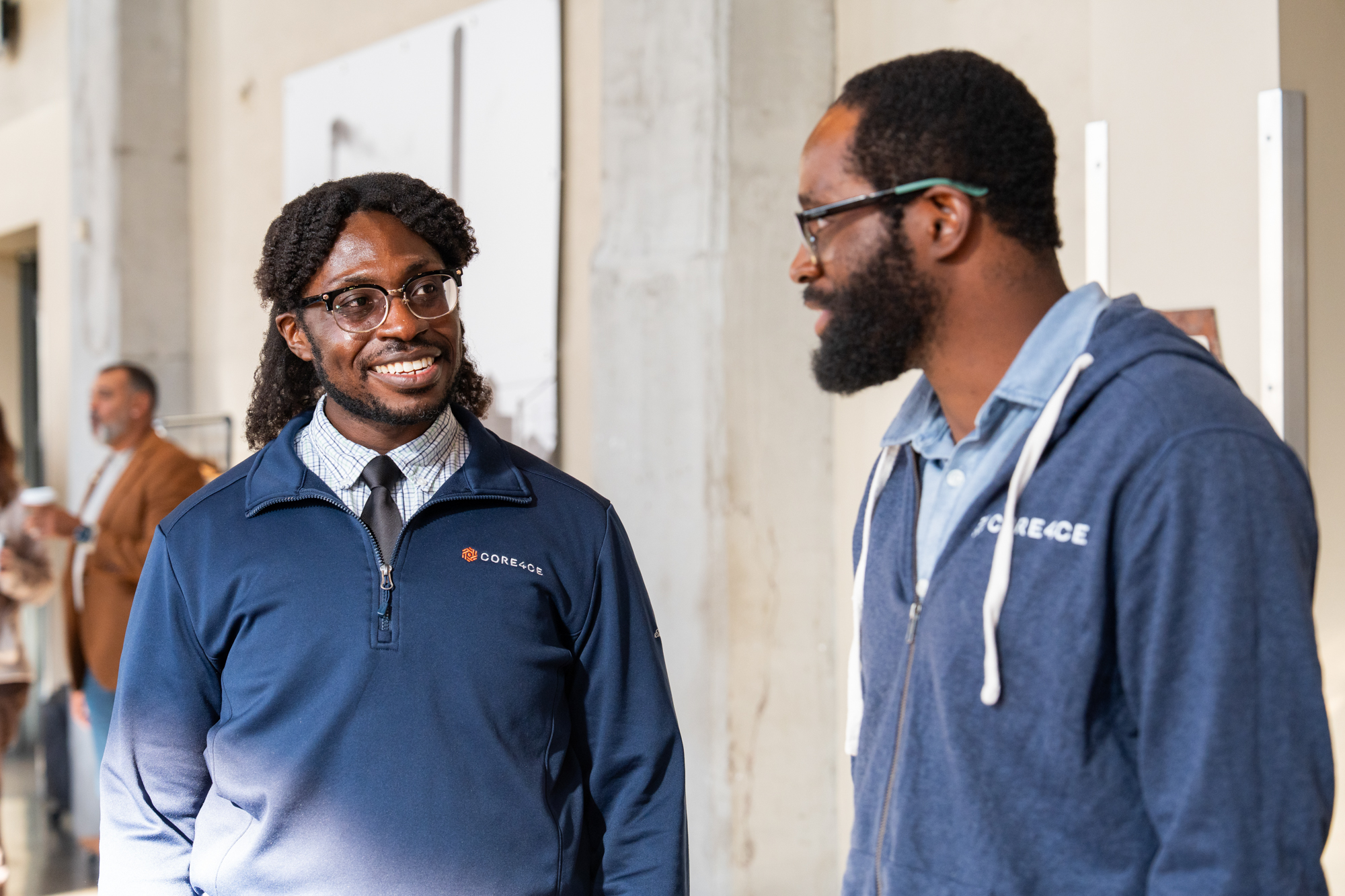
R&D Summit Presenters Dr. Ighodalo Idehenre (left) and Dr. Morris Olumba (right)
Materials development at AFRL
Dr. David Turner took the audience inside crystal growth and materials synthesis at AFRL. He covered six lines of work:
- Next-generation nuclear fuel research with the Department of Energy, in one of the few labs in the world able to make novel formulations
- Low-cost, hand-held neutron detectors that can be deployed anywhere
- Laser-quality crystals for directed energy and communications, taken from crystal growth to a fieldable prototype laser
- New substrate materials for high-power electronics that are more durable and radiation hardened
- High-temperature glass for high-speed flight
- Environmental barrier and thermal protection coatings for vehicles traveling above Mach 5
The message on nearly every slide was the same: “We are making it.”
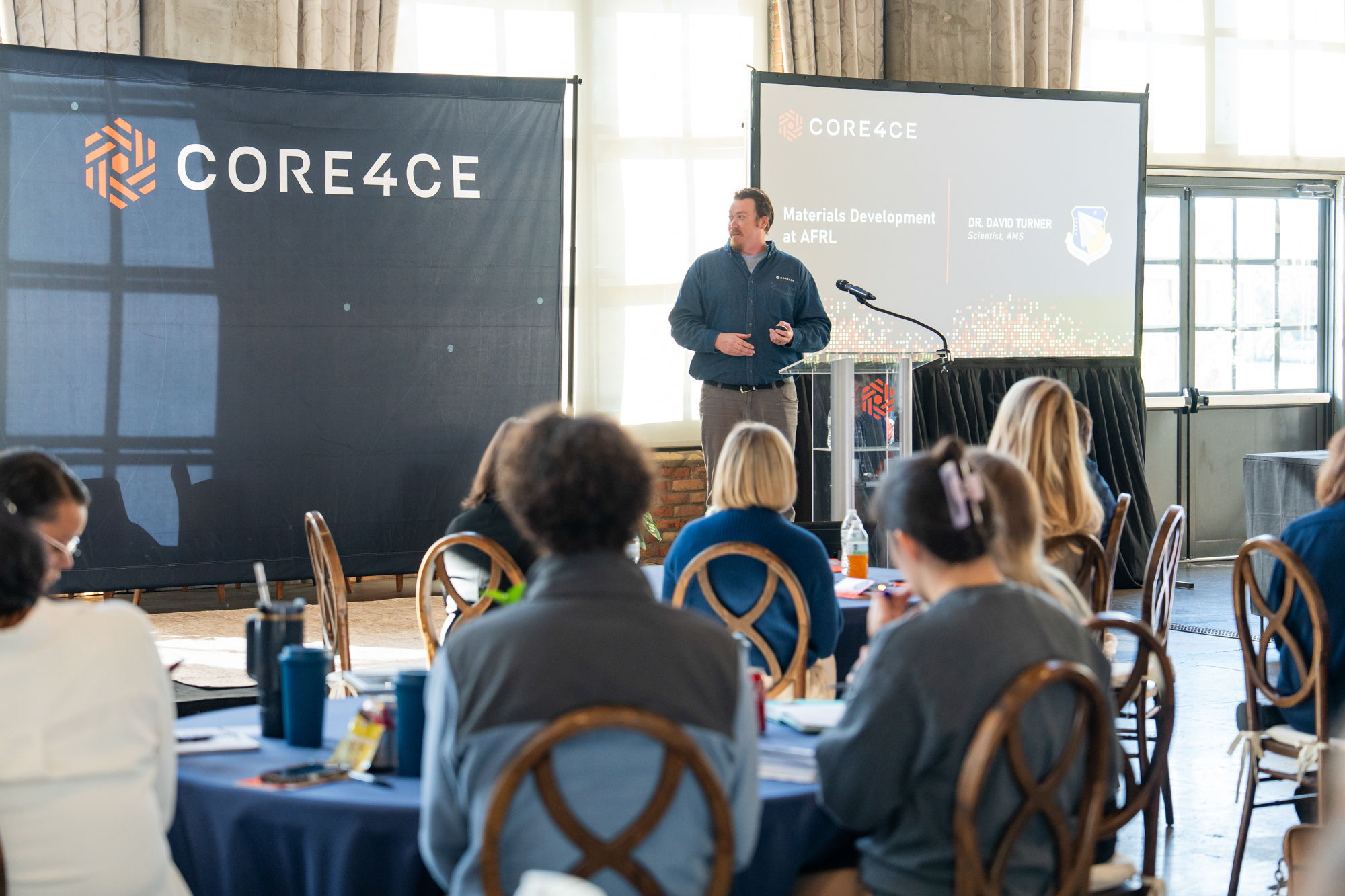
Dr. David Turner
The automated lab
A panel of Ecklin Crenshaw, Dr. Steven Wolf, and Dr. Chris McLeese, moderated by Alex Bender, looked at how robotics, software, and connected data are changing the lab. Automation lets researchers test more ideas, get more consistent results, and support more projects at once. The panelists stressed that it takes more than buying equipment: workflows, software, and data systems all have to be redesigned. Scientists stay at the center, with more of their time spent on design and interpretation instead of repetitive work.
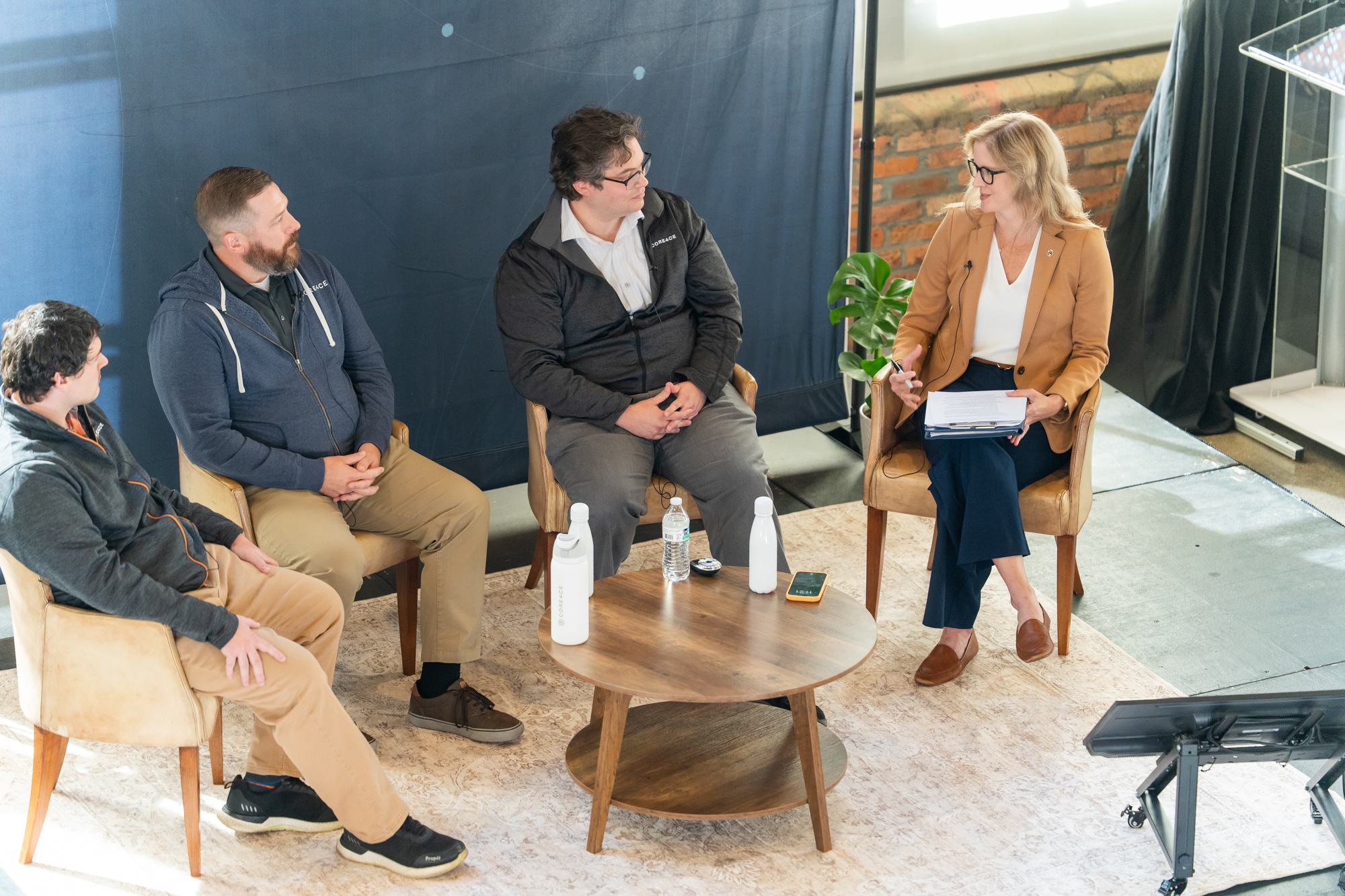
From left to right: Dr. Steven Wolf, Dr. Christopher McCleese, Ecklin Crenshaw, and Alex Bender
Materials for next-generation defense electronics
Two panels drew on Core4ce’s TOPS work for AFRL. In the first, moderated by Dr. Rick Fingers, Dr. Daram Ramdin, Dr. Kelsey Collins, and Dr. Jose Flores introduced ferroelectric and ferroic materials. These materials could enable faster, smaller, lower-power memory and more agile radio frequency systems for radar, communications, and electronic warfare.
In the second, moderated by Cayla Valadez, Dr. Brent Noesges, Dr. Prescott Evans, and Dr. Jian Li made the case for ultra-wide bandgap semiconductors. These materials could produce power electronics that run hotter, handle more power, and waste less energy than today’s technology. Both panels came back to the same challenge: moving a promising material from the lab into a device at scale, fast enough to keep the United States ahead.
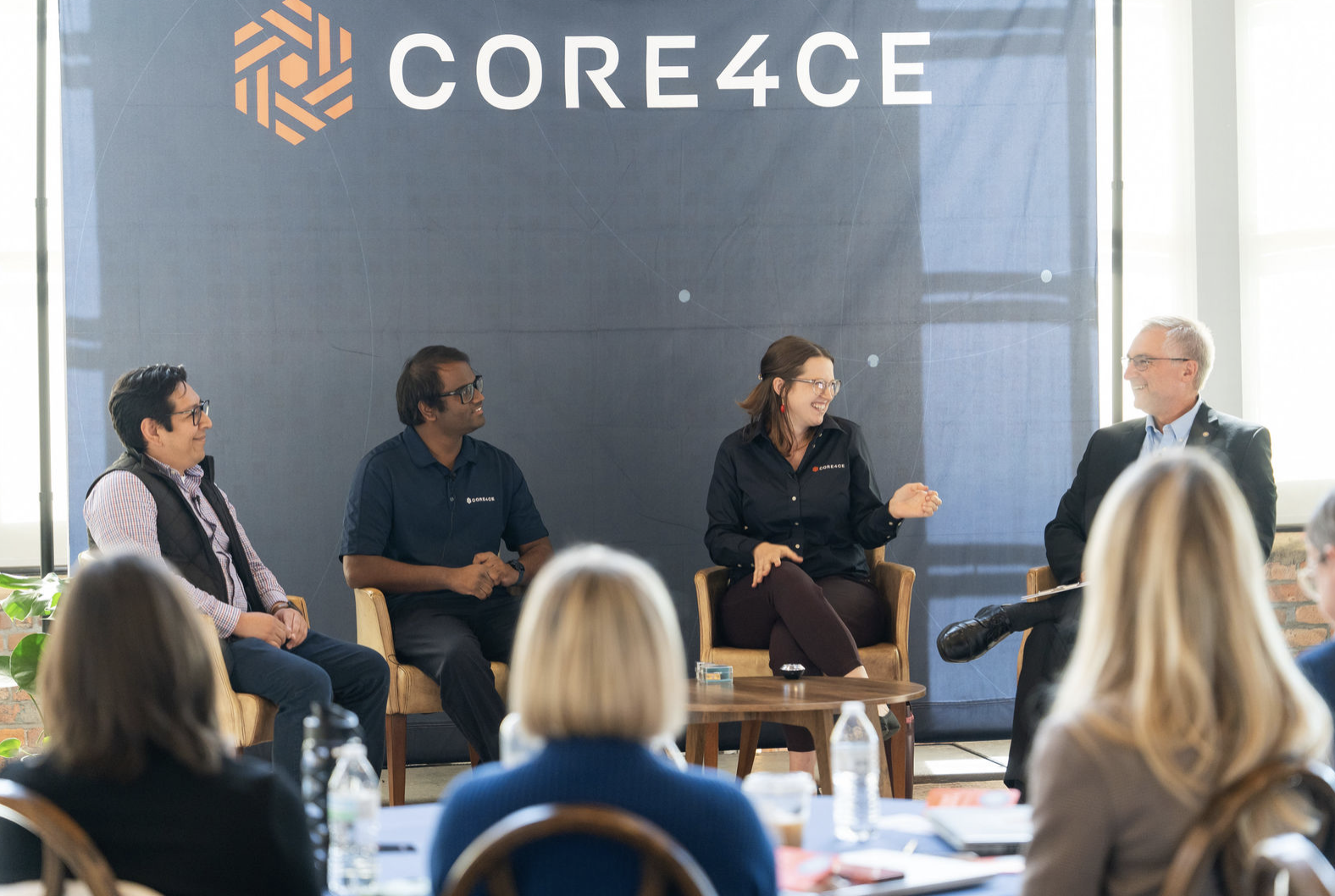
From left to right: Dr. Jose Flores, Dr. Daram Ramdin, Dr. Kelsey Collins, and Dr. Richard Fingers
Photonics for contested environments
The afternoon closed with two panels on the MaRSS II program. Moderated by Ian Brown, Eleanor Coyle, Dr. Eric Suter, and Dr. Mulaine Shih explained how simulation, inverse design, and scientific software let researchers test optical designs digitally before building them. Then Scott Pearl moderated Dr. Mike Brennan, Dr. Stephanie Amtry, and Dr. Morris Olumba on the physical side of the work. They covered transparent ceramics and single crystals, bio-inspired optical coatings, and the realities of scaling up crystal growth.
Together, the two panels showed modeling and experiments working hand in hand to make sensors and optical systems smaller, lighter, and better protected.
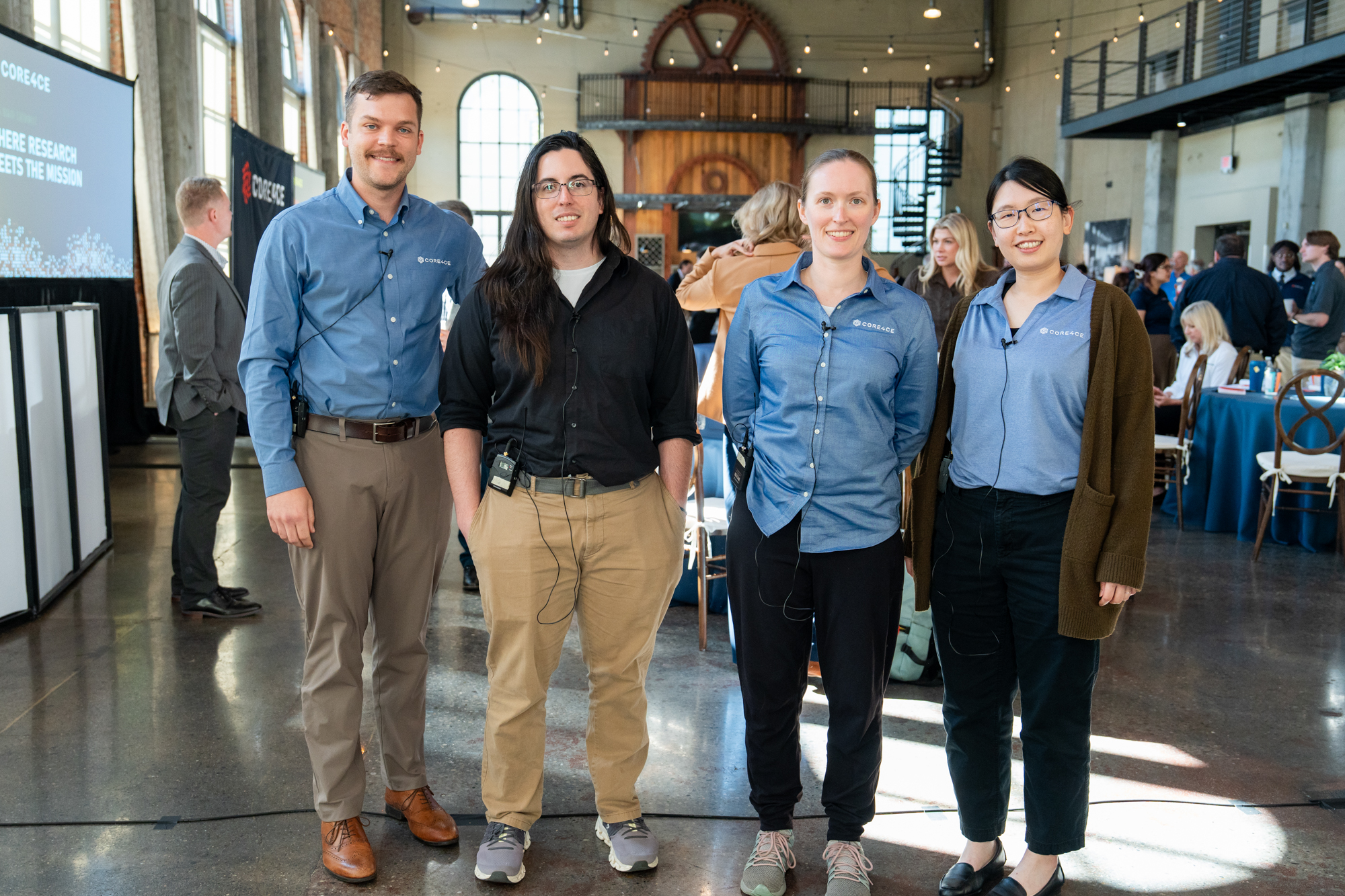
From left to right: Ian Brown, Dr. Eric Suter, Eleanor Coyle, and Dr. Muhlaine Shih
Core4ce Managing Partner and CTO Todd Harbour closed the day before attendees moved to the on-site reception.
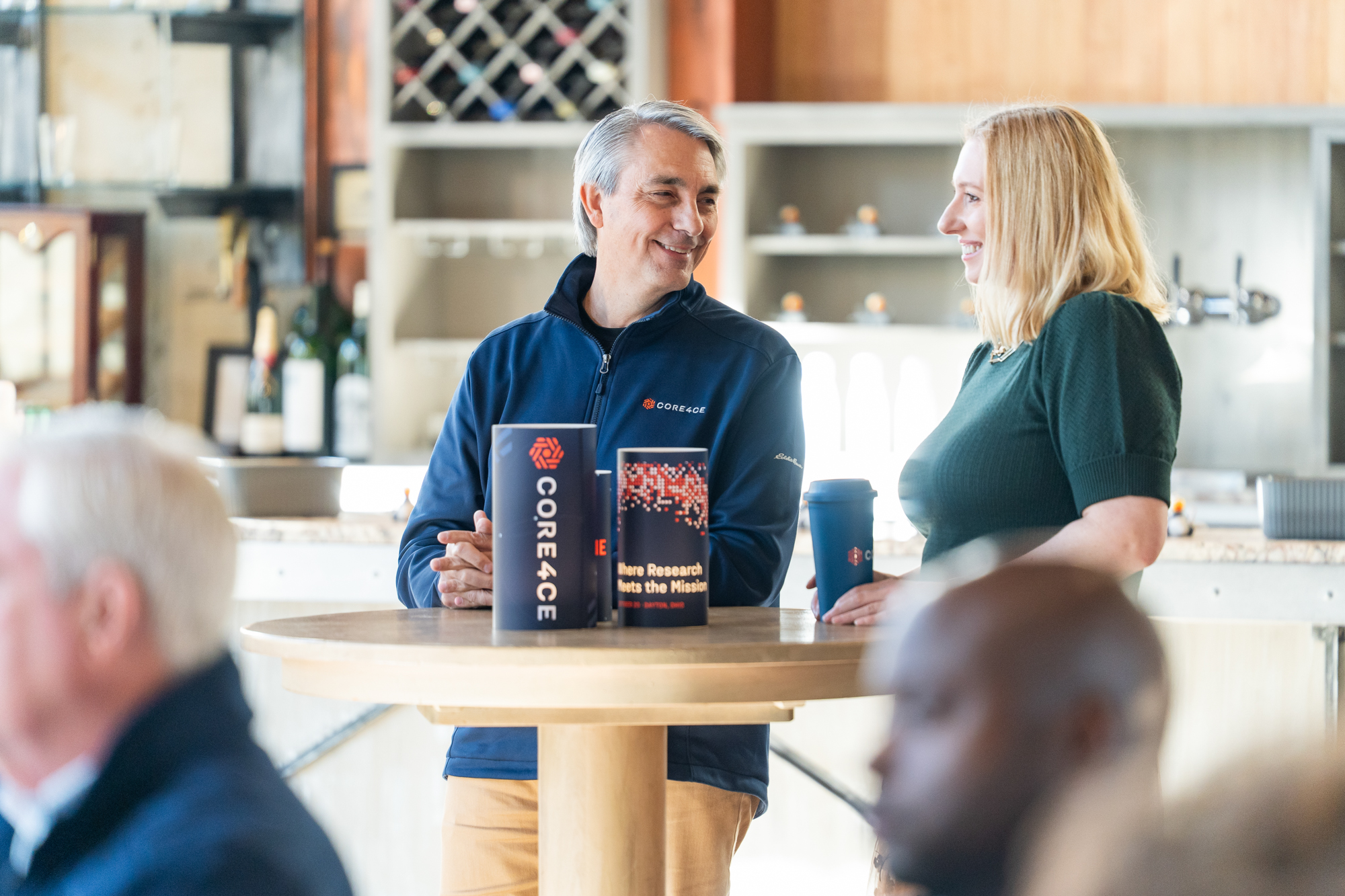
Core4ce Managing Partner and CTO Todd Harbour and SVP, Operations Danielle Castleberry
WHAT’S NEXT
Two years after the Azimuth acquisition, Core4ce’s Dayton team plays an integral role in advancing the company’s mission to serve as a trusted national security partner. Its materials scientists, data and AI engineers, and software developers work side by side with AFRL and the wider defense community. The summit showed the thread that connects their work: physical science and digital tools, used together, keep research tied to the mission it serves.
Join us. Core4ce is hiring scientists, engineers, and software developers in Dayton and across the country.
Explore Open Positions with Core4ce