
By Dr. Richard Fingers, Technical Strategist, Core4ce
Rare earths are not a new topic. The strategic challenge they present is well known. What is becoming more urgent is the need to decide where to act first.
Today, roughly 80 to 90 percent of the world’s rare earth supply chain runs through China. At the same time, there is no current substitute for rare earth materials in many of the technologies that matter most to national defense, energy systems, and advanced manufacturing. That combination creates a serious vulnerability.
The question is no longer whether this is a problem. The question is where we can get the biggest bang for the buck in addressing it.
That is the work in front of us now.
The challenge is bigger than finding rare earths
When people talk about rare earths, the conversation often begins with access to raw materials. But this is not just about finding rare earth deposits. It is about building a supply chain that can withstand disruption.
If we remain dependent on a supply chain concentrated in one geopolitical competitor, then any disruption—whether economic, political, or industrial—can have ripple effects across critical technologies and defense systems. Supply chain resilience has to mean more than availability. It has to mean the ability to absorb perturbations and continue delivering what the mission requires.
That is why a serious assessment must look across the whole chain, not just at where the material originates.
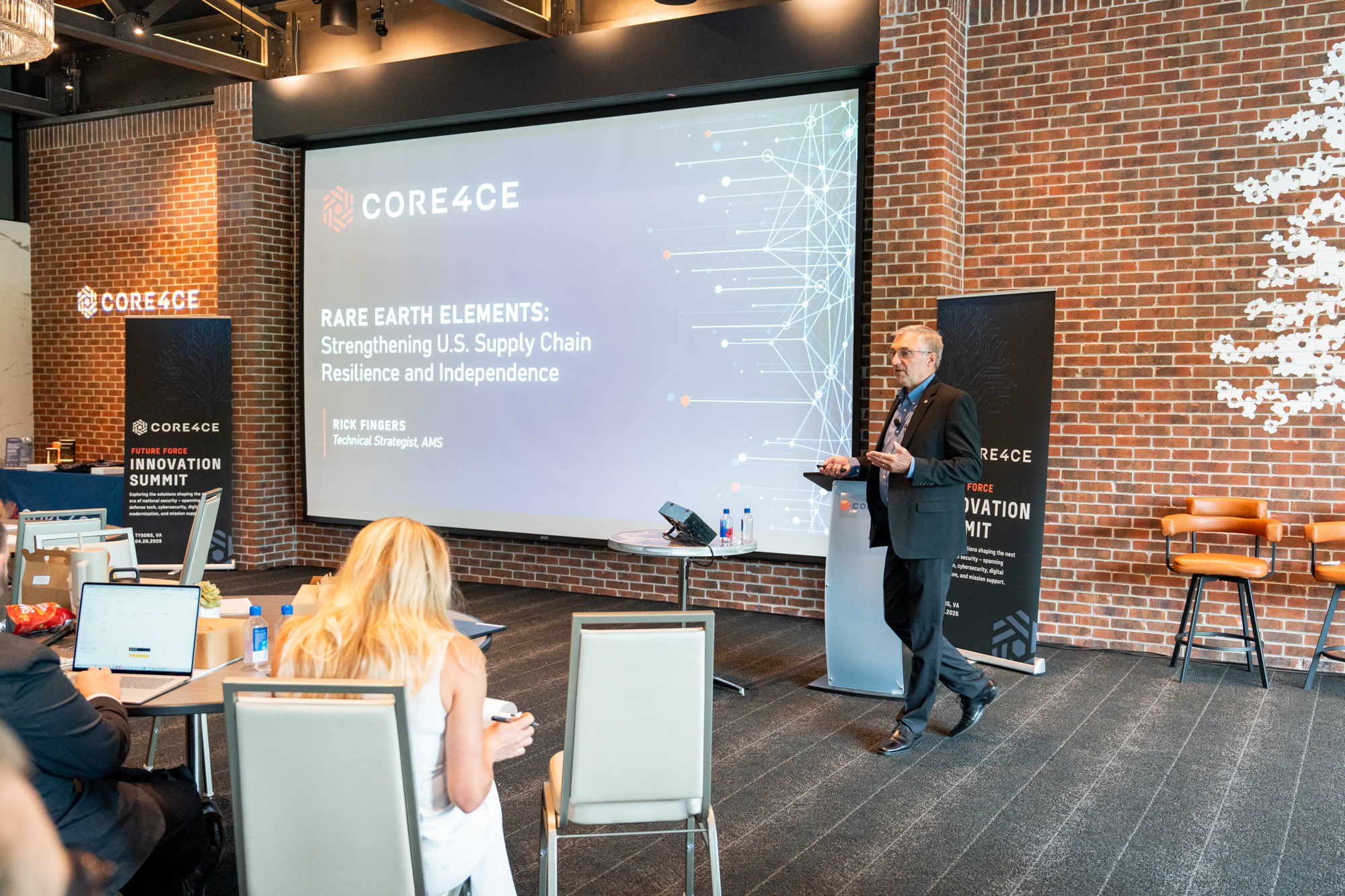
Dr. Richard Fingers speaking at Core4ce’s 2026 Innovation Summit
An investment strategy must prioritize impact
One of the clearest needs in this space is a practical investment strategy. If government is going to put resources against this challenge, it needs to know where those resources will make the most difference.
That means taking a hard look at the supply chain and asking a few direct questions:
- Where are the most critical weak links?
- Where should investment be made first?
- Which actions can create near-term impact?
- Which opportunities require a longer horizon of five to ten years?
Those are the kinds of answers organizations like AFRL need in order to make informed decisions. Research funding matters, but it matters even more when it is directed toward the points in the system where it can reduce dependency and improve resilience.
In my view, we need to be able to provide both a strategic horizon and a near-term path to action. Some investments will naturally play out over five to ten years. That is the reality of research, development, and technology transition. In addition, there are areas where we can make a difference sooner. We must identify those areas and act on them immediately.
AI can help identify the most critical links
This area is where AI can be useful in a very practical way.
The rare earth supply chain is complex. It spans mining, physical and chemical processing, manufacturing, logistics, and end-use technologies. It also involves multiple nations, commercial actors, and policy environments. That complexity makes it difficult to assess by intuition alone.
AI and advanced technical analysis can help identify the most critical links in the supply chain and show where intervention is likely to matter most. If we can use those tools to determine where investment should go today, then we can help decision-makers act with more confidence and speed.
That is where organizations with the right mix of technical specialists, mission understanding, and AI-enabled analysis can contribute in a meaningful way. At Core4ce, that combination of expertise is what makes this kind of problem especially important—and especially actionable.
Some opportunities are long-term. Others may be available now.
A realistic strategy has to acknowledge different time horizons.
The broader effort to strengthen rare earth resilience will take time. Industrial capacity does not appear overnight, and research-based investments often require years to transition into operational or commercial impact.
At the same time, I believe there are some things—particularly in chemical processing—that could make a difference much sooner. Those opportunities deserve attention because near-term gains can help reduce risk while larger strategic investments continue to mature.
We should not think about this as a choice between immediate action and long-term planning. We need both.
AUKUS creates a meaningful opportunity
Another important part of this discussion is allied cooperation.
The United States has an opportunity to work more closely with Australia and the United Kingdom under AUKUS. That trilateral relationship provides a valuable umbrella for collaboration, and it may also create opportunities to address some of the most pressing vulnerabilities in the rare earth supply chain.
Australia in particular has an important role to play, and stronger collaboration among trusted partners can help reduce concentration risk and support a more resilient supply chain overall.
If we are serious about changing the current dynamic, allied coordination has to be part of the strategy.
This work is ultimately about readiness
For all the discussion of supply chains, investment planning, and industrial capacity, the reason this work matters is simple.
We want the people we send into harm’s way to have the best technical advantage possible.
That is the standard.
The importance of rare earths is not just economic. It is operational. It affects the systems our military depends on and the capabilities that support national defense. When we talk about resilience in this area, we are talking about our ability to equip and support the people who serve.
That is why this issue deserves serious attention—and why a clear-eyed, technically informed investment strategy is so important.
The problem is not new. But the need to act with focus and urgency is.